78%
Five-year sustained recovery
PHP-monitored physicians completing five-year monitoring without substance-related relapse.
McLellan, Skipper, Campbell, DuPont (2008). 904 physicians across 16 state PHPs. BMJ.

Reweave Care
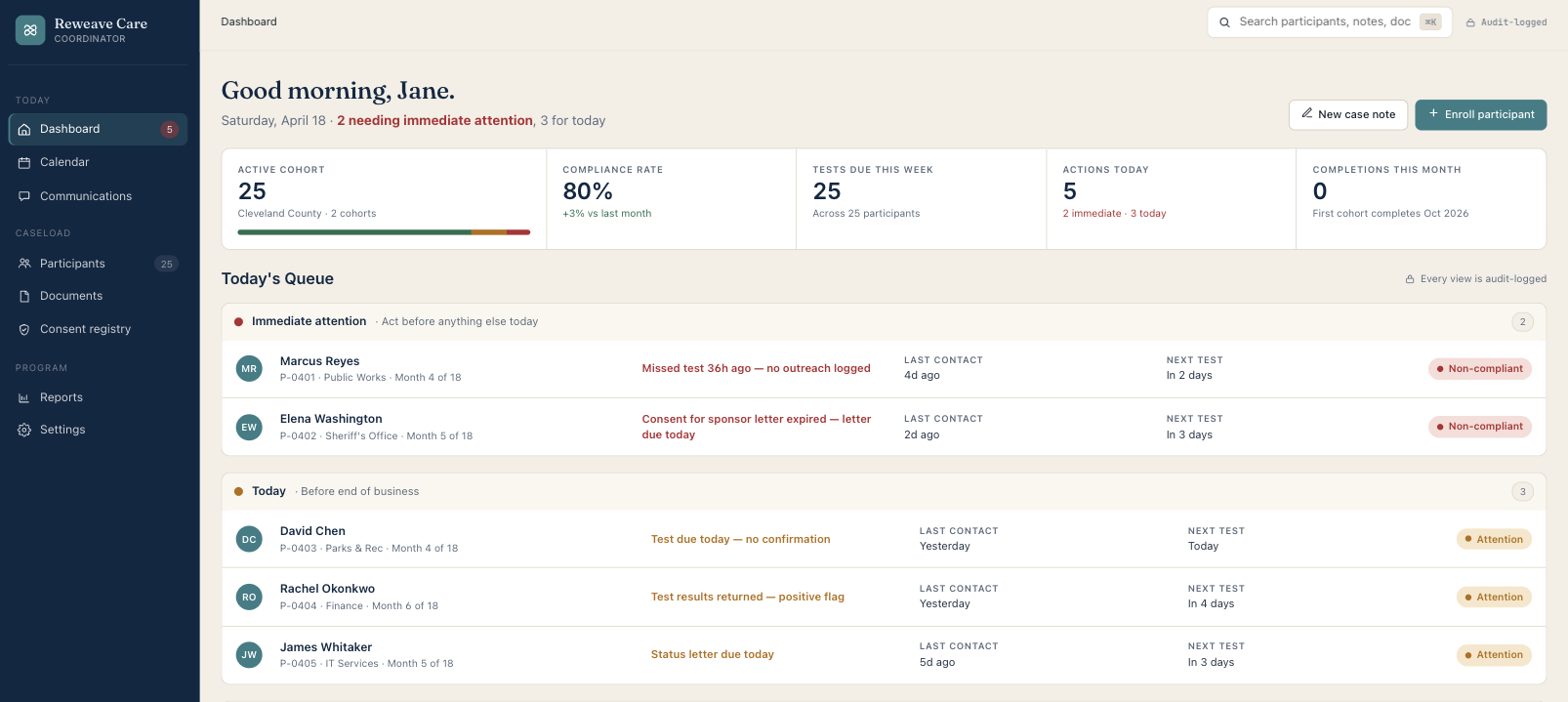
The platform clinical organizations and program administrators use to run professional recovery monitoring programs. Built on consent-first architecture. Multi-stakeholder by design.
What Reweave Care is
Reweave Care sits in a specific position in the recovery monitoring stack. On one side is the testing infrastructure: lab providers, point-of-care devices, breathalyzers, urine and hair tests. On the other side is everyone who depends on the results: the participant, the counselor, the medical director, the licensing board, the employer, the program coordinator who runs it all.
The middleware position is the strategic one. Testing providers cannot credibly build the case management layer on top of their own testing business without commodifying it. Treatment EHRs document clinical care but do not coordinate the multi-stakeholder workflow recovery monitoring requires. Generic case management tools do not understand the consent, disclosure, and reporting structure this work needs. The middle layer has been empty.
Consent and release management is the architectural backbone, not a feature bolted on. Every data flow on the platform passes through a scoped, auditable consent layer.
Outcomes
Recovery monitoring built around multi-stakeholder coordination has the strongest peer-reviewed evidence base in addiction medicine. The data is older than Reweave Care. The framework is what we are putting modern infrastructure under.
78%
Five-year sustained recovery
PHP-monitored physicians completing five-year monitoring without substance-related relapse.
McLellan, Skipper, Campbell, DuPont (2008). 904 physicians across 16 state PHPs. BMJ.
75%
Continued license retention at 5 years
Same cohort, retained licensure five years after entering monitoring.
McLellan et al. (2008). BMJ.
8–26%
Recidivism reduction
Across 23 adult drug courts, monitored participants showed reduced 18-month recidivism vs. traditional case processing.
Multi-Site Adult Drug Court Evaluation (MADCE), 2011. NIJ-funded.
Capabilities
Six capability areas anchor the platform. The disciplines below are how the work gets done, not features in a marketing list.
Per-enrollment, per-recipient, per-data-category consent records with effective dates, expirations, and revocation. Consent posture, disclosure, and access are three separate concepts that the platform keeps separate. The structure is what lets the platform operate cleanly under HIPAA and 42 CFR Part 2.
Encrypted monthly compliance letters generated for each participant's employer or accountability contact. Binary by default: in compliance, or not in compliance. Optional detail paths available when program rules require them. Distributed with full audit trail.
A unified participant record aggregating identity, enrollment, monitoring agreement, testing history, check-ins, meetings, counseling, documents, and correspondence. Coordinators run intake, build per-participant plans across testing, counseling, and meetings tracks, and manage the work queue from a single workspace.
The platform ingests testing events, results, and check-ins from multiple sources. RecoveryTrek integration. Direct lab CSV upload. PDF document ingestion as a first-class pattern. Manual entry where automation cannot reach. Provider-agnostic from day one.
Every read, write, disclosure, consent change, and authentication event is logged with user, timestamp, IP, affected record, and (for disclosures) recipient. Logs are append-only, hash-chained, and exported to bucket-locked Google Cloud Storage outside the application. The record holds up under regulatory audit and evidentiary scrutiny.
Role-based access control with fine-grained organizational scoping. Configurable email and SMS notifications. CSV and PDF data export honoring access controls. Direct lab API integrations and remote monitoring device support are on the roadmap.
Compliance posture
Reweave Care is purpose-built for the regulatory frameworks that govern professional recovery monitoring. The compliance posture is unusually detailed because buyers in this space specifically look for it.
Encryption in transit (TLS 1.3) and at rest (AES-256). SSO and MFA for staff users via Cloud Identity Platform. Business Associate Agreements with all subprocessors. Breach notification workflow. De-identification tooling for any research or benchmarking exports.
Built to operate as a substance use disorder program of record under 42 CFR Part 2, including the 2024 Final Rule aligning Part 2 with HIPAA, now in enforcement since February 2026. The consent and disclosure architecture honors the disclosure rules Part 2 requires.
Hash-chained, append-only audit log with bucket-locked Google Cloud Storage export. Defensible in regulatory audit and evidentiary contexts. Load-bearing in PHP, healthcare-system, public-sector, and drug-court engagements where evidentiary standards apply.
Reweave Solutions, LLC executes Qualified Service Organization Agreements with Part 2-covered programs and Business Associate Agreements with HIPAA-covered entities. The contracting structure puts Reweave inside the regulatory perimeter as a service provider, not outside as a third party.
Integrations
Reweave Care does not bind to a single testing provider. The first integration is with RecoveryTrek, the most established testing provider in physician health programs. Direct CSV upload and PDF ingestion are first-class patterns from day one, not afterthoughts.
Programs that work with multiple labs, point-of-care devices, or off-the-shelf testing services connect each one through the same normalized data model. The platform stays vendor-neutral as the program evolves.
Who uses Reweave Care
The user we design for is the program coordinator at the clinical organization. Case manager, navigator, intake specialist. The person who runs the day-to-day work of the program. They serve the participants. The people whose recovery depends on the program staying with them.
Every minute the coordinator does not spend wrangling data is a minute they can spend on the participant in front of them. The work is recovery. The technology should make more of it possible.
Other roles in the organization (medical director, program director, board liaison, employer sponsors) interact with the platform through what the coordinator builds, configures, and reports. Reweave Care is workspace software for the operators of regulated programs.
For clarity
The category labels around recovery monitoring are noisy. Three disclaimers, said plainly, before the conversation goes any further.
Reweave Care does not replace clinical documentation systems used inside treatment facilities. It coordinates the recovery monitoring workflow that sits adjacent to and downstream of treatment.
Reweave Care is purpose-built for the consent, disclosure, and reporting structure that recovery monitoring requires. Generic case management tools do not understand this structure.
See it in operation
We want to understand the program before we discuss what implementation could look like. From there, the path forward gets specific quickly.
Request a conversation